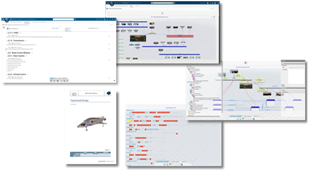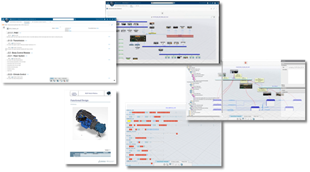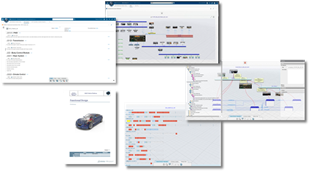
Avionics Architect
Ensure consistency of Avionics architectures data, of complex Aircraft systems, to prepare, by connecting the dots, detailed design.
Role
Analyze Stakeholders Needs & Requirements to Specify and Simulate Best Solutions Trade Off
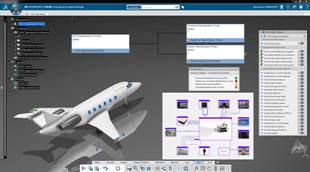
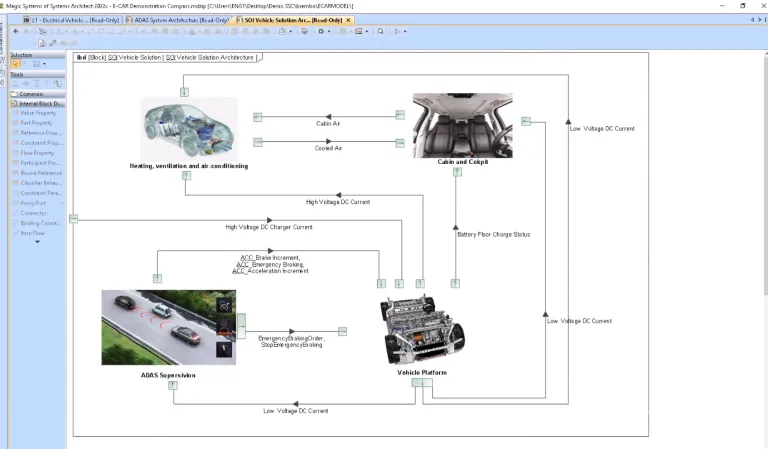
Systems Architecture solutions enables to capture multiple stakeholders needs to analyze systems missions, define operational concept and model the system with its subsystems and their interfaces. CATIA Magic portfolio empower Enterprise Architects and Systems Architects to model all aspects of complex systems with the most standard-compliant models and diagrams, leveraging SysML, UAF, UML and other key industry standards.
This Model-Based Systems Engineering (MBSE) approach support multiple scales modeling & simulation:
Support Systems Architects to specify every aspect of a system, ranging from stakeholder requirements analysis to functions and components definition across engineering disciplines. Stakeholder requirements and architecture models can be shared and reviewed in a collaborative environment. Systems architecture is modeled, from operational architecture to functional and logical decomposition using industry-proven SysML standard.
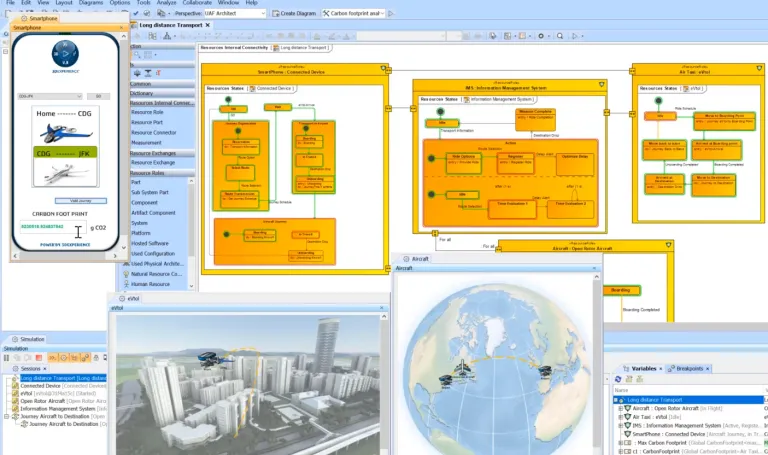
System of systems modeling and simulation enables to elaborate the optimal concept of operations to achieve high performance missions. Its intuitive system of systems modeling supports key UAF, NAF, MODAF Standards. Architect can easily represent and communicate complex system of systems concepts, to facilitate multiple stakeholders and multiple organization and enterprises understanding to reach mission objective.
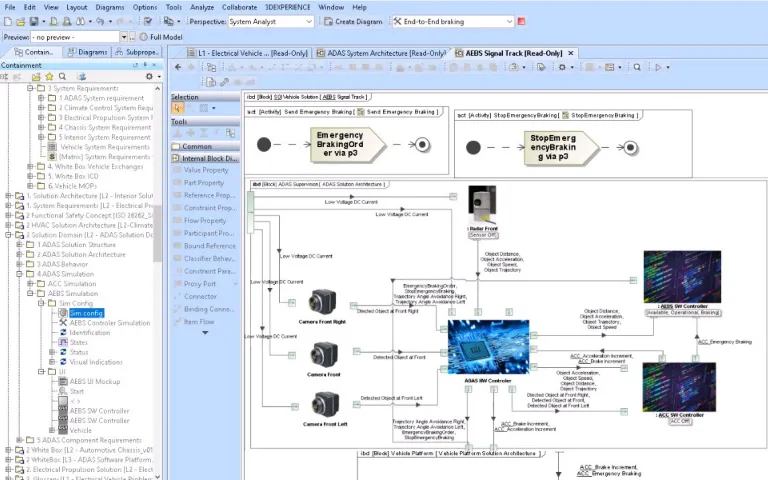
Systems Architecture models can be executed, enabling to test how the system reacts to user interaction or predefined testing data and execution scenarios. It enables to virtually predict system behavior before deriving requirements to specify with accuracy the solution and taking into consideration uncertainties to make solution trade-offs for early decision-making. The system completeness and consistency can be analyzed with simulation, improving specification quality and preventing rework loops or test and integration issues.
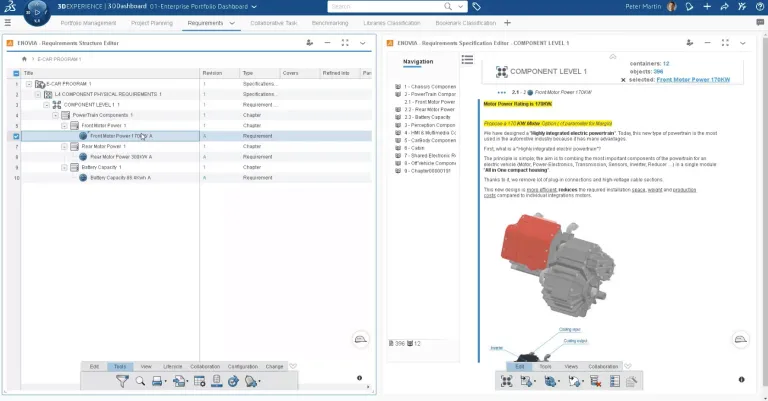
Capture requirements from multiple sources and tools, enabling to establish a unified repository and improve team collaboration among the product development phases. Leveraging Requirement Engineer solution, elicit, refine and track requirements from initial “Voice of the Customers” and Stakeholders needs, up to the detailed technical specifications for product design. Validation & Verification strategy can be associated to systems specifications to identify any gap in requirements coverage. Ease standards and regulations compliance thanks traceability and change management control.
CATIA Systems Architecture software products are packaged as Roles on the 3DEXPERIENCE platform to get you up to speed faster and work more efficiently with all needed applications available at your fingertips. Select a package that corresponds to your role in an organization.
Ensure consistency of Avionics architectures data, of complex Aircraft systems, to prepare, by connecting the dots, detailed design.
Role
Complex systems design & Validation in the context of industrial programs
Role
Ensure consistency of Electrical, Electronics & Software architectures data, on industrial vehicle systems, to prepare, by connecting the dots, detailed design.
Role
Ensure consistency of Electrical, Electronics & Software architectures data, on complex vehicle systems, to prepare, by connecting the dots, detailed design.
Role
The world of Systems Architecture and Speciation is changing. Discover how to stay a step ahead with CATIA
Using a standard language simplifies engineering complexities between mechanical, electrical, software, and other components.
Article
The SE commision of UCODS is pleased is pleased to announce its next webinar : "From Needs to Tests" which will take place on October 14, 2026 at 05:00 pm (French Time)Register at the following link:https://www.ucods.eu/event/from-needs-to-tests-56/registerWebinar Description : This webinar showcases a unified, collaborative approach from requirements management (TRM) to test management (VRP)
CATIA MBSE CYBER SYSTEMS
This is amazing new integration sample of flexible web based UI. Based on highly configurable ALM web based solution - Tuleap. Solution is for non-modeler to capture business data and automatically transition it to world wide recognized standard of the model in OMG UAF. Solution is covering UAF strategy, operational, resources model generation including elements, relations and diagrams. OverviewT
CATIA MBSE CYBER SYSTEMS
Hi,Is there a published format of a Cameo Collaborator Document? For example, is it possible to access the links with a collaborator document? How is the collaborator document stored? Thank you, Maria DAgostino
CATIA MBSE CYBER SYSTEMS
SysML v2 gives shapes, coordinate frames and units a meaning that tools can reason over. Lets overview SysML v2 geometry capabilities from a ten-line car envelope to requirements that are rechecked in CATIA / 3DEXPERIENCE.Full demo:https://youtu.be/4SHATeLi2o8 Note: All figures are renders and screenshots from running models.An orbital station of about 150 parts. Every shape and every position i
CATIA MBSE CYBER SYSTEMS
Global Model-Based Systems Engineering Solutions
Ensure Product Design Consistency across Disciplines, Leveraging Modeling and Simulation
Continuously Integrate, Test & Validate Embedded Software & Systems to Manage End-to-End Traceability
End-to-End Model-Based Solutions for Mechatronics & Software-Driven Experiences
Ensure Product Design Consistency across Disciplines, Leveraging Modeling and Simulation
Continuously Integrate, Test & Validate Embedded Software & Systems to Manage End-to-End Traceability
Speak with a CATIA expert to learn how our solutions enable seamless collaboration and sustainable innovation at organizations of every size.
Courses and classes are available for students, academia, professionals and companies. Find the right CATIA training for you.
Find information on software & hardware certification, software downloads, user documentation, support contact and services offering