Collaborative Designer for CATIA SCANeR
Accelerate and secure tomorrow’s mobility solutions using virtual twin for design & validation of AD/ADAS & headlights
Role
Continuously Integrate, Test & Validate Embedded Software & Systems to Manage End-to-End Traceability
Integration, Test, Validation and Verification processes are facing key challenges arising from the complexity, scale, real-time, safety and security constrains of products and systems.
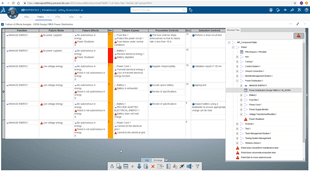
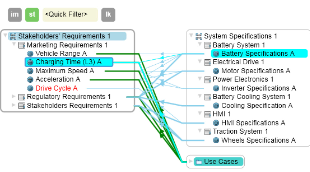
Thanks to Virtual Twin Experience, complex systems can be modeled and simulated taking into account their requirements and hardware and software disciplines - even starting at the very beginning of the product development cycle. Simulation Analysts and Test Engineers can continuously test and validate system's design, behavior, and performance are aligned with the customer's expectations and market regulations. End-to-End traceability enable to trace heterogeneous data in extended enterprise, from initial requirements to hardware/software deliveries and test results. It reduces iteration loops and eases compliance audit and systems certification.
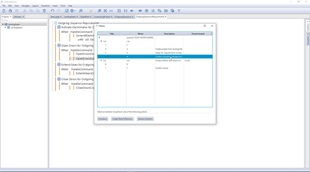
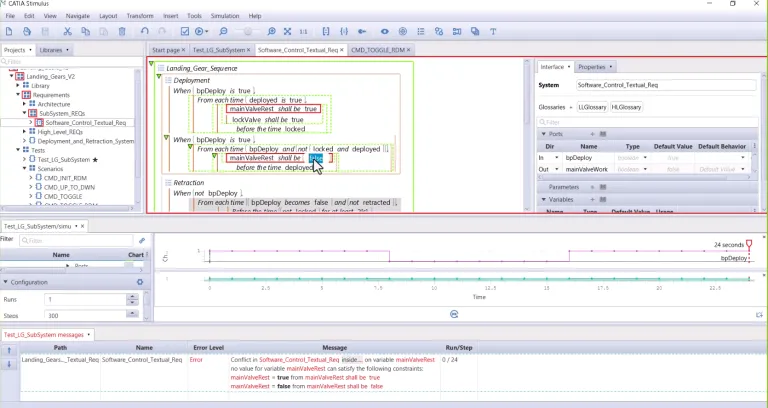
Defect and errors are sometimes introduced at specification phases and very difficult to detect for safety-critical embedded systems. CATIA STIMULUS deliver a paradigm shift in System Validation, where Requirement in the loop simulation can be performed at specification stage and re-use during integration test and validation. At specification phase, system architects can detect ambiguous, incorrect, missing, or conflicting requirements before the design begins. At validation phase, Test Engineers can automate test generation and check embedded software code complies with its specifications.
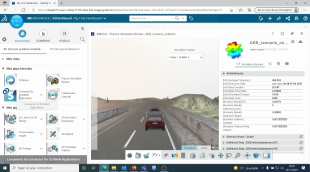
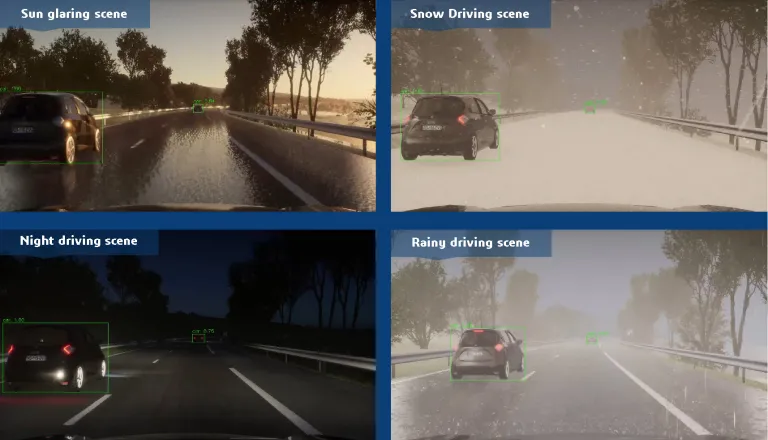
Highly automated systems, such as Advanced Driver Assistance Systems (ADAS) or Automated Driving (AD), face a unique challenge: testing in unpredictable environments. Massive Virtual Simulation with CATIA SCANeR empowers the execution of model, software, and human-in-the-loop simulations within realistic environmental conditions. This approach allows the identification and virtual simulation of edge cases and critical scenarios, ensuring to reach a confident level of quality and safety before these groundbreaking innovations are introduced to the market.
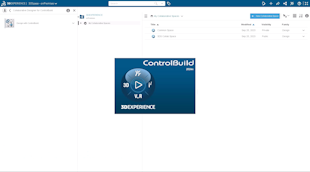
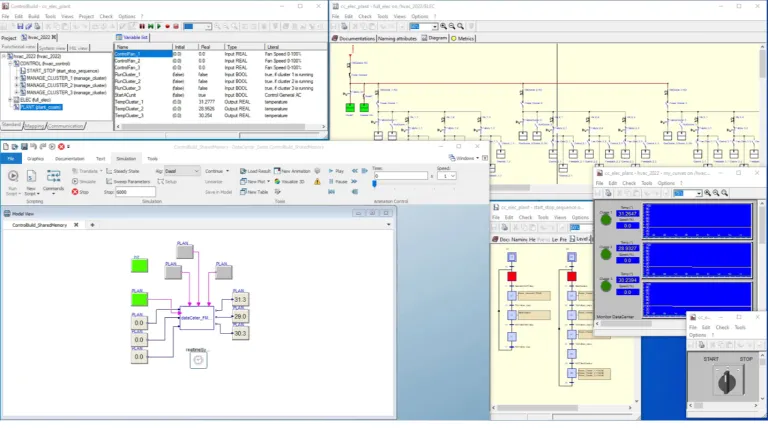
The Control & Monitoring system represents more than 30% of the total cost of the delivered system in Trains and Railways, Automotive, Energy and many other industries (Life Sciences, Water Treatment, Industrial Equipment, Food & Beverage, etc.). These new systems will offer a number of functionalities and high-quality services while meeting increasingly stringent certification constraints. ControlBuild is used to model, simulate, test, validate, and deploy control applications, in compliance with industry IEC-61508 and EN-50128 safety development standards.
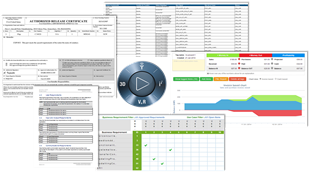
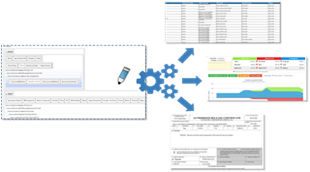
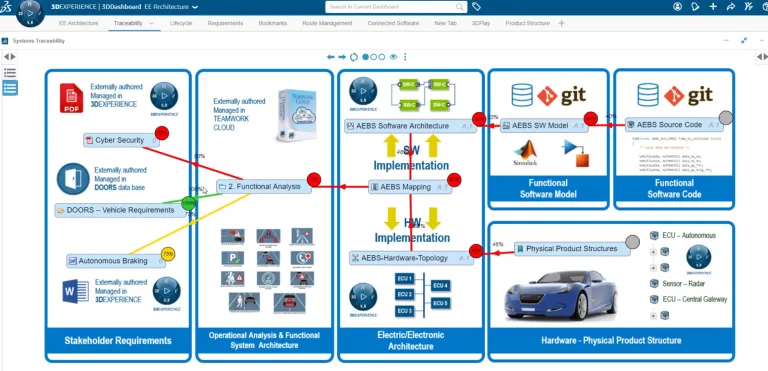
Traceability and Report Generation solutions facilitate collaboration among interdisciplinary teams from requirement to hardware/software to test deliveries review. Impacts of changes from systems architecture, model-based design, implementation or validation can be identified, resulting in risk mitigation. Traceability from heterogeneous tools, models and data source support Project leader, Quality & Certification Engineer to demonstrate effective integration of regulatory and safety requirements throughout the entire development process and to automatically generate reports for certification basis.
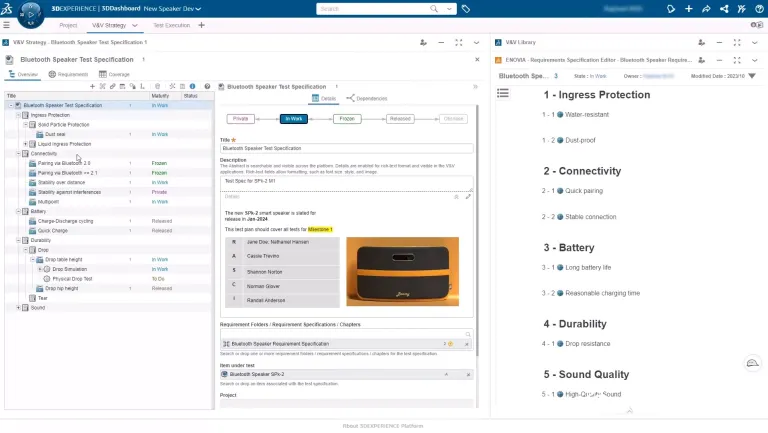
To avoid costly recall, secure every aspect of the product is rigorously tested by defining test specifications and by reusing proven test methods templates. Assess how test strategies match the requirements, functional, logical, or physical aspects of the system under test. Schedule and manage test executions a monitor the overall execution progress and maturity. Link and trace tests results evidence to easily support compliance to regulations and standards.
CATIA Systems Validation software products are packaged as Roles on the 3DEXPERIENCE platform to get you up to speed faster and work more efficiently with all needed applications available at your fingertips. Select a package that corresponds to your role in an organization.
Accelerate and secure tomorrow’s mobility solutions using virtual twin for design & validation of AD/ADAS & headlights
Role
Control systems design & Validation in the context of industrial programs
Role
Enables an end-to-end simulation and validation of systems requirements, from specifications to validation tests
Role
Ensure documentation consistency with engineering data thanks to on-demand report generation based on templates.
Role
Accelerate documents creation by defining templates which integrate any data from different sources for automatic generation.
Role
Reduce iteration loop by supporting collaboration and traceability in extended enterprise
Role
Reduce iteration loop by supporting collaboration in extended enterprise
Role
The End-to-End MBSE and Test Automation Solution
End-to-End Traceability
Multi-Engineering Modeling and Simulation based on Modelica and FMI
Revolutionizing Autonomous Vehicle Testing and Simulation
The SE commision of UCODS is pleased is pleased to announce its next webinar : "From Needs to Tests" which will take place on October 14, 2026 at 05:00 pm (French Time)Register at the following link:https://www.ucods.eu/event/from-needs-to-tests-56/registerWebinar Description : This webinar showcases a unified, collaborative approach from requirements management (TRM) to test management (VRP)
CATIA MBSE CYBER SYSTEMS
This is amazing new integration sample of flexible web based UI. Based on highly configurable ALM web based solution - Tuleap. Solution is for non-modeler to capture business data and automatically transition it to world wide recognized standard of the model in OMG UAF. Solution is covering UAF strategy, operational, resources model generation including elements, relations and diagrams. OverviewT
CATIA MBSE CYBER SYSTEMS
SysML v2 gives shapes, coordinate frames and units a meaning that tools can reason over. Lets overview SysML v2 geometry capabilities from a ten-line car envelope to requirements that are rechecked in CATIA / 3DEXPERIENCE.Full demo:https://youtu.be/4SHATeLi2o8 Note: All figures are renders and screenshots from running models.An orbital station of about 150 parts. Every shape and every position i
CATIA MBSE CYBER SYSTEMS
Hi,Is there a published format of a Cameo Collaborator Document? For example, is it possible to access the links with a collaborator document? How is the collaborator document stored? Thank you, Maria DAgostino
CATIA MBSE CYBER SYSTEMS
Ensure Product Design Consistency across Disciplines, Leveraging Modeling and Simulation
Analyze Stakeholders Needs & Requirements to Specify and Simulate Best Solutions Trade Off
End-to-End Model-Based Solutions for Mechatronics & Software-Driven Experiences
Speak with a CATIA expert to learn how our solutions enable seamless collaboration and sustainable innovation at organizations of every size.
Courses and classes are available for students, academia, professionals and companies. Find the right CATIA training for you.
Find information on software & hardware certification, software downloads, user documentation, support contact and services offering